Chain Reaction, Autumn 2006
The scientific and business community are still struggling to understand the global public rejection of genetically engineered (GE) foods, and with the growing discourse around the risks and disruptive impacts of nanotechnology, many are becoming increasingly worried that history is about to repeat itself. There is a blossoming of reports and conferences that explore ‘From bio to nano’ and how governments can avoid ‘fighting the last war’. PR consultancies and think-tanks are doing a roaring trade in communications advice and ‘upstream engagement’ tools to minimize the risk of backlash. However, it is becoming clear that virtually all of the issues that have made GE food so controversial are also present with nanotechnology. The only real question that remains for executives and politicians worried about a nano backlash is… when?
In some ways, the outrage over GE was the accumulated and unexpressed outrage over the role of industrial agriculture and chemical companies in our lives for the past fifty years. It was a gut-level reaction that the industrial experiment had gone far enough. When pesticides were first introduced, it was done with little or no knowledge by the general public of the negative effects, and it was done when the modern environmental and consumer movements had yet to develop. However, 40 years after Rachael Carson wrote ‘Silent Spring’, after 4 decades of creeping revelations about the health and environmental impacts of industrial agriculture, after 4 decades of increasing public skepticism about the impacts of science, the public was not willing to idly accept the next major technological experiment with the environment and with their health.
Social movements don’t spring out of nowhere. They emerge and grow within a context – a mixture of culture, counter-culture, hopes, fears and ideas. The dramatic rejection of GE foods in the mid-late 1990’s was a trigger event in a movement that started long before. The groundwork was laid by the many groups who had been campaigning against GE since the mid 1980’s, so by the time Monsanto started planting commercial GE crops in the US in 1996, there was a clear political, social, intellectual and cultural context for the movement to flourish. The public was recently attuned to the problems of industrial food systems following BSE and other food/health scares, and was already distrustful of chemical companies. The obvious and immediate question over GE foods was, and still is, who benefits and who bears the risks? The answer was obvious. So was the response.
The official debate about GE has largely been limited to a narrow discussion of risk – involving an assessment of both the probability of some negative event happening, and the magnitude of the consequences. However, theorists such as Ulrich Beck have argued that the potential consequences of new technologies such as nuclear fusion and biotechnology render this traditional risk assessment approach inadequate because of the new and potentially massive scale of the consequences and the fact that, in the long run, the least likely event will occur. But even this critique misses what has been one of the primary sticking points for public acceptance of GE foods - the simple fact that the people who create the risks are not necessarily the ones who accept the consequences. Why should a person or a community accept any level of risk whatsoever if there is no benefit for them? On the otherhand, it is easy to see why companies are less concerned about creating and imposing risks if they are not accountable for consequences.
The mainstream debate on risk has flourished because it essentially leaves the paradigm of technological development intact. The basic assumption is that new technologies will be introduced unless a relatively narrow scientific assessment indicates that there will be negative impacts. This is in stark contrast to the model proposed by many critics of GE who argue that the burden of proof should be reversed – and that proponents of risky new technologies should be required to prove safety prior to introduction of their products. There is a rather compelling argument that both the probability of negative effects of genetic engineering, and the scale of any negative consequences are fundamentally unpredictable. Thereby justifying a precautionary and enduring ban on the release of GE organisms into the environment.
Despite the early stage of technology adoption, the debate about nano risks is already quite well developed. This is probably due to a combination of a number of factors, including a more active regulatory and public/media context around risk following 10 years of relentless public conflict over GE. The other factors are the similarities between nanoparticle toxicity and the known toxicity of other ultra-fine particles (vehicular emissions etc) and the doyen of public health scandals – asbestos. However, issues of direct environmental and health risks are only one small part of a bigger picture. The introduction of transformative new technologies also raises more fundamental questions about values and ideas about our future.
The problem is that it has somehow become taboo to contest ideas. It’s as if industrial capitalism is somehow not an idea and is therefore exempt from scrutiny, while anything else can be dismissed as ‘ideology’ – a slur that implies a lack of critical perspective. At this point, it is worth asking what kind of society is it where anyone who raises criticisms of new technology is immediately derided as an ideologue and a luddite? It’s almost as though science has achieved a quasi-religious status, where bio and nanotech might well be regarded as the new creationism.
So what are the values that underpin the coming nanotechnology revolution? To answer this question, we need to ask a few closely related questions. Who is funding the technology? In whose interests is it being developed? To what end? How are decisions being made about the technology and by whom? The short answer is that nanotechnology is primarily being developed by the world’s largest corporations and by the US military in order to introduce a range of new products and processes either for the purposes of increasing profits or extending military supremacy. While there are some genuinely interesting and possibly beneficial applications of nanoscience, this is not where the real action is and certainly isn’t what is driving research agendas.
At a fundamental level, the debate over nanotechnology will be about democracy. It will be about our future and who gets to define it. About who benefits and who bears the negative impacts. That’s what the GE campaign is about, and that’s what is at stake with nano. In the absence of a cautious and responsible approach by governments and industry to such a powerful set of technologies, the community is faced with little choice but to put the brakes on - using whatever means are possible.
John Hepburn
For more information about nanotechnology, risk and democracy, visit http://nano.foe.org.au
Thursday, June 22, 2006

Monday, May 15, 2006
After the Thaw

Great events in human history are captured in our memories like fish in ice at the sudden onset of winter. Frozen in time, to be thawed and trawled out in generations to come by curious grandchildren. What were you doing when it happened? Where were you? Who were you with? How did you feel?
Most of these defining moments are shared. The event happens. News flashes around the globe. For a moment we are transfixed, shocked, in awe. JFK has been assassinated…the Berlin Wall came down… the planes hit the twin towers… bonds are created as we share in the tragedy or the elation of the moment.
I recently experienced the defining moment of my generation - the event to dwarf all others. But strangely, I had it all to myself, staring at an email on my computer screen as I struggled to comprehend… humans are changing the climate.
My great grandchildren are unlikely to care about September 11, or about John Howard, or who won the world cup in 2006. They’re going to want to know how, in the space of only 4 generations, we created a mass wave of extinctions by triggering a climatic shift so dramatic that evolution was left flailing in it’s wake. And they’re going to want to know why my generation didn’t do anything when we knew it was happening.
Late last year, scientists revealed that the Siberian permafrost is melting. Researchers found that an area of permafrost spanning a million square kilometres - the size of France and Germany combined - has started to melt for the first time since it formed 11,000 years ago.
The area in question, covering the entire sub-Arctic region of western Siberia, is the world's largest frozen peat bog and scientists fear that, as it thaws, it will release billions of tonnes of methane, a greenhouse gas 20 times more potent than carbon dioxide, into the atmosphere.
It is yet another example of a scenario climate scientists have feared since first identifying "tipping points" - delicate thresholds where a slight rise in the Earth's temperature can cause a dramatic change in the environment that itself triggers a far greater increase in global temperatures. The news managed to climb to the dizzy heights of story number 6 on the radio news. The lead story has already slipped from memory.
Much like the thaw of the permafrost or the dawn sweeping across the landscape, the realization that climate change is real and catastrophic spreads slowly. While I’ve had an intellectual understanding of climate change for many years and have followed the scientific developments with increasing concern, at some deeper level it just hadn’t sunk in. Now it has. And it’s not the loss of skiing holidays that is most concerning – it’s the loss of life.
A 2004 study published in Nature magazine examined the extinction risk from climate change in six biodiversity-rich regions, representing one fifth of the Earth's land area. The researchers concluded that from 15 to 37% of all the species in the regions studied could be driven to extinction by the climate changes likely between now and 2050. Climate change and the impacts of industrialization and over-consumption are driving a mass wave of extinction that is leading many scientists, like world famous paleoanthropologist, Dr. Richard Leakey, to predict that up to 50% of all species will be extinct within the next 100 years.
To put this in context, the fossil record reveals five great extinction episodes in the last half-billion years. The last happened 65 million years ago when dinosaurs became extinct. It has been calculated that the current rate of extinction is one thousand to ten thousand times the background rate – and rising. To draw the blunt but obvious conclusion - humans are now causing the sixth mass wave of extinctions in the 4 billion year history of life on earth.
Nature has always had to adapt to changing climate conditions. Indeed, it is one of the driving forces behind the process of evolution that has produced the staggering variety of life on Earth. But the very real fear is that the changes currently under way are simply too rapid for species to evolve new strategies for survival.
People can pack up their gear into cars and move (at least, wealthy people can). We can build dwellings. We can grow food in greenhouses. Other creatures can’t. Humans are incredibly adaptive to change – it is one of our greatest qualities, and, so it would appear, one of our greatest liabilities as we go about resigning ourselves to accept climate change.
A lot of us seem to have forgotten that our life depends on functioning ecosystems. Food, medicines, clean air and water are the obvious things. Maybe we really can keep living with dramatically reduced diversity of life on earth? But given that we only have the slightest clue about what life actually exists, let alone what functions it performs in keeping our global environment in equilibrium, it’s a pretty big gamble. It’s a bit like letting a neurologist remove 90% of your brain because they only know what 10% of it does. If there is one thing that we have learnt about ecology over the past 50 years it is that natural systems are complex and symbiotic. Changing one thing invariable results in flow on effects.
In the face of the enormous challenge posed by climate change, our elected political leaders are flailing aimlessly. The oil and coal industries have such a stranglehold over our economy and our public institutions that they stymie any attempts at change. Political parties on the right and left are beholden to big energy and are paralysed by a chronic failure of the imagination.
At this point, we don’t just need a 10% renewable energy target. We don’t need people just to buy energy efficient light bulbs. We certainly can’t pin our hopes on just cleaning up coal. We need a radical and urgent transition plan to a green economy. We need a green development programme that will make the Marshall Plan look like a Sunday school picnic. The transition away from destructive industries and their replacement with efficient, sustainable alternatives needs to be the basis of the next industrial revolution.
It’s not even worth saying that it won’t be easy. It will take the combined energies of our best planners, economists, artists, engineers, teachers, managers, scientists and farmers to make it happen. We already have a host of brilliant and practical ideas from some of the brightest and most creative thinkers of our time. What we lack is the collective courage and leadership to make the investments and to take risks - investments and risks that are commensurate with the size of the challenge. The consequences of the doing nothing are just far too devastating and irresponsible to contemplate.
My father spent his whole working life in the coal industry. The challenge of his generation of engineers was to grow and to manage the industrial revolution. They didn’t know about climate change back then. My first three years as a graduate engineer in the early 90’s were spent designing and building equipment for the coal, oil and gas industries. I didn’t really know about climate change then either. Now I do. And the thing about being human is that we have the capacity to learn from history. And between stimulus and response we have choice.
It seems clear enough. Either we rise to meet the challenge of our age - or we don’t. If we do, it will require a political movement to transform our economy – with a role for every single one of us. If we don’t, then our current political and business leaders will be inscribed in the record books as the drivers of, and collaborators in, the most senseless and destructive chapter in human history. And the rest of us will be secure in the anonymity of spectatorship – at least until those grandchildren start asking pesky questions.
Monday, May 08, 2006
Size matters - public opinion doesn't
Canberra Times, 8th May 2006
The release last month of a Federal Government discussion paper on the development of a national nanotechnology strategy created ‘nano ripples’ throughout the community – so small as to be imperceptible to the human eye. Nanotechnology is being heralded as the next industrial revolution, redefining life as we know it, but with only one month for public comment, the development of a national strategy to manage the most powerful and transformative technology in human history will involve less public participation than a development application to retrofit your local pub. Given the stakes, it is high time that we sat up and started paying attention to the way this technology is set to reshape our world – and in whose interests.
The release of the discussion paper coincided with the first ever recall of a nanotechnology product. In Germany, there were 39 cases of serious respiratory problems and six people were hospitalized in late March after using the nanotech bathroom cleaner "Magic Nano". While it is not yet clear if nanotechnology is to blame for these health problems, the important point is that no government anywhere regulates nano-scale materials if the same chemical substance has been vetted at the macro-scale. Yet it is precisely because nano materials behave differently to their macro-scale counterparts that they are attracting so much investment and research interest.
Nanoparticles are generally understood to be particles below 100 nano metres in size (about one eighty thousandth of the width of a human hair) that take advantage of property changes that occur at the nano-scale. Nano-scale materials may be more reactive, have different optical, magnetic and electric properties, and be much stronger or more toxic than their larger scale counterparts. For example, aluminum oxide - used in dentistry because of its inertness - can spontaneously explode at the nano- scale and is currently being tested as a potential rocket fuel.
There are a wide range of concerns with nanotechnology, not least of which is the issue of nanotoxicity. The defense systems of the human body are generally not designed to deal with such small particles. In general, nanoparticles of 70 nanometres can enter the lungs, a 50 nm particle can enter cells and a 30 nm particle can pass through the blood / brain barrier.
In response to concerns over health and environmental safety, the Royal Society in the United Kingdom released a report in 2004 with a series of wide ranging recommendations. They recommend that “Until more is known about the environmental impacts of nanoparticles and nanotubes, their release into the environment should be avoided as far as possible”; and that “Ingredients in the form of nanoparticles undergo a full safety assessment before they are permitted for use in products”.
The problem is that the regulators are not listening. As the scientific evidence of nano hazards continues to mount, so does the number of products containing nanoparticles that are already on the shelves – from sunscreens to cosmetics, car parts and even food.
Beyond the immediate health and environmental risks, the more complex and far-reaching implications of nanotechnology are a little further up the development pipeline. Molecular manufacturing techniques for putting together products atom-by-atom and the merging of non-living nano-materials and living organisms have the power to literally re-make our world from the atom up, and to fundamentally change our relationship with the natural world.
However, readers of the discussion paper issued by the Australian Government’s National Nanotechnology Taskforce would be none the wiser about such issues. The aim of the paper seems to be to reassure the reader that nanotechnology isn’t really new and certainly isn’t anything to worry about. The speculative benefits of nanotechnology are pronounced with certainty from on high, while questions of risk, and even known hazards are heavily qualified and the waters muddied.
It is clear that there is an urgent and growing regulatory gap, where nano product development is being fast-tracked at the expense of environmental health and safety. If recommendations from the Royal Society, one of the world’s most conservative and well-respected scientific bodies haven’t triggered a regulatory response, it is unclear what will. Perhaps the nanotechnology industry is waiting for the same kind of consumer and environmental backlash that emerged over genetically engineered foods?
The transformative power of the new nanotechnologies signals that it is time for us to take the democratisation of science seriously. Over the past 200 years, scientists have altered our world as much, if not more than elected officials, yet they are accountable to nobody save the corporations that increasingly fund them. We need a new way of thinking about science and technology that allows the development of technology to be shaped by the needs of the community and the environment — not the other way around. Just as scientists are exploring uncharted territory through the emerging nanotechnologies, so must we also explore uncharted territory in terms of how these technologies are managed — and crucially, in whose interests. The development of a nanotechnology strategy for Australia deserves far more public involvement and scrutiny than it is currently being given.
For more information about Nanotechnology, visit www.nano.foe.org.au
The release last month of a Federal Government discussion paper on the development of a national nanotechnology strategy created ‘nano ripples’ throughout the community – so small as to be imperceptible to the human eye. Nanotechnology is being heralded as the next industrial revolution, redefining life as we know it, but with only one month for public comment, the development of a national strategy to manage the most powerful and transformative technology in human history will involve less public participation than a development application to retrofit your local pub. Given the stakes, it is high time that we sat up and started paying attention to the way this technology is set to reshape our world – and in whose interests.
The release of the discussion paper coincided with the first ever recall of a nanotechnology product. In Germany, there were 39 cases of serious respiratory problems and six people were hospitalized in late March after using the nanotech bathroom cleaner "Magic Nano". While it is not yet clear if nanotechnology is to blame for these health problems, the important point is that no government anywhere regulates nano-scale materials if the same chemical substance has been vetted at the macro-scale. Yet it is precisely because nano materials behave differently to their macro-scale counterparts that they are attracting so much investment and research interest.
Nanoparticles are generally understood to be particles below 100 nano metres in size (about one eighty thousandth of the width of a human hair) that take advantage of property changes that occur at the nano-scale. Nano-scale materials may be more reactive, have different optical, magnetic and electric properties, and be much stronger or more toxic than their larger scale counterparts. For example, aluminum oxide - used in dentistry because of its inertness - can spontaneously explode at the nano- scale and is currently being tested as a potential rocket fuel.
There are a wide range of concerns with nanotechnology, not least of which is the issue of nanotoxicity. The defense systems of the human body are generally not designed to deal with such small particles. In general, nanoparticles of 70 nanometres can enter the lungs, a 50 nm particle can enter cells and a 30 nm particle can pass through the blood / brain barrier.
In response to concerns over health and environmental safety, the Royal Society in the United Kingdom released a report in 2004 with a series of wide ranging recommendations. They recommend that “Until more is known about the environmental impacts of nanoparticles and nanotubes, their release into the environment should be avoided as far as possible”; and that “Ingredients in the form of nanoparticles undergo a full safety assessment before they are permitted for use in products”.
The problem is that the regulators are not listening. As the scientific evidence of nano hazards continues to mount, so does the number of products containing nanoparticles that are already on the shelves – from sunscreens to cosmetics, car parts and even food.
Beyond the immediate health and environmental risks, the more complex and far-reaching implications of nanotechnology are a little further up the development pipeline. Molecular manufacturing techniques for putting together products atom-by-atom and the merging of non-living nano-materials and living organisms have the power to literally re-make our world from the atom up, and to fundamentally change our relationship with the natural world.
However, readers of the discussion paper issued by the Australian Government’s National Nanotechnology Taskforce would be none the wiser about such issues. The aim of the paper seems to be to reassure the reader that nanotechnology isn’t really new and certainly isn’t anything to worry about. The speculative benefits of nanotechnology are pronounced with certainty from on high, while questions of risk, and even known hazards are heavily qualified and the waters muddied.
It is clear that there is an urgent and growing regulatory gap, where nano product development is being fast-tracked at the expense of environmental health and safety. If recommendations from the Royal Society, one of the world’s most conservative and well-respected scientific bodies haven’t triggered a regulatory response, it is unclear what will. Perhaps the nanotechnology industry is waiting for the same kind of consumer and environmental backlash that emerged over genetically engineered foods?
The transformative power of the new nanotechnologies signals that it is time for us to take the democratisation of science seriously. Over the past 200 years, scientists have altered our world as much, if not more than elected officials, yet they are accountable to nobody save the corporations that increasingly fund them. We need a new way of thinking about science and technology that allows the development of technology to be shaped by the needs of the community and the environment — not the other way around. Just as scientists are exploring uncharted territory through the emerging nanotechnologies, so must we also explore uncharted territory in terms of how these technologies are managed — and crucially, in whose interests. The development of a nanotechnology strategy for Australia deserves far more public involvement and scrutiny than it is currently being given.
For more information about Nanotechnology, visit www.nano.foe.org.au
Tuesday, February 14, 2006
Creating an ecological, workers co-op - a case study of 'Reverse Garbage'
 In case anyone hadn’t noticed, our economy is killing the planet. It also commits millions of people to live in poverty and is creating an ever-widening gap between rich and poor. Some of us think that we should do something about it.
The failures are systemic and the solutions also need to be systemic. We need fundamental changes in the way that we think about our relationship with each other and with the earth, and changes in the fundamental power relations in society. Not only do we need to challenge the existing power structures (stop inappropriate development, pollution etc), but we also need to build alternatives – alternative economic systems, alternative political systems, and alternative cultural and social norms.
We already have plenty of technological fixes. The thing that we need to get a whole lot better at is the political and economic fixes. We need to learn how to work co-operatively, we need to learn how to do real democracy at a local community level, we need to learn how to create an ecological economy – now! We can’t wait for experts to teach us what to do. We need to learn by doing. The change that is required for sustainability is going to be led by local communities. It is going to be messy, we’re going to experiment, get things wrong, get things right and move on.
This essay is a history of one attempt at starting an ecologically based, worker managed co-operative in Brisbane, Australia. It is one of many experiments happening all over the world aimed at creating viable models for ecologically sustainable economic and community development. This is written 6 years after we started Reverse Garbage so we have the benefit of at least a little hindsight – to learn what worked and what didn’t – what to replicate and what to avoid.
There tends to be a lot of woolly thinking about ‘alternative models’ – which are often promoted well beyond their capacity to deliver worthwhile results. Part of this problem is excessive self promotion driven by the need to obtain funding. However, another part is the pervasive sense of hopefulness whereby people switch off their critical faculties when they encounter nice people trying to do good things. It is useful to remember that Nice is most usefully thought of as an acronym for “Not Insightful or Critical Enough” and, if we are going to succeed in replacing the current model of doomsday economics with something more life affirming and sustainable, we are going to have to subject alternatives to critical scrutiny.
In that vein, this essay provides a brief (and personal) history of the creation of Reverse Garbage Co-op in Brisbane. It is partly a history of people, places and goings on, and partly an analysis of ideas and their practical application.
If Reverse Garbage is the answer, what was the question?
Working with Friends of the Earth Brisbane at the end of 1997, a few of us were asking the following questions:
q How can we earn a living doing something that makes a positive contribution to the environment and to our community?
q How can Friends of the Earth develop a secure source of ongoing funding that fits with their vision and the values and that doesn’t compromise the integrity of the organisation?
q How can we start creating an alternative, sustainable and equitable local economy as a way to help encourage and inspire broader change?
The idea
We were inspired by the Wombles. It seemed that there had to be opportunities to live off the discards of our wasteful, industrial society. Whenever you walk past an industrial skip you see valuable materials destined to be buried in the ground. Our economy systematically destroys ecosystems in order to create ‘products’, which we then fail to use efficiently and turn into another environmental problem through landfill. Because this is common practice, it is easy to think of it as normal – which it isn’t. It is actually insane and grossly inefficient, not to mention morally reprehensible in light of the flow-on ecological and social consequences.
After travelling around the east coast of Australia looking for interesting models of recycling businesses that work, there were two obvious options:
- re-use of industrial discards (Reverse Garbage in Sydney and Melbourne)
- tip shops (Hobart, Canberra)
Initial evaluation
It became evident that a tip shop, while possible, was going to take quite a long time to establish in Brisbane due to the constraints of the waste management infrastructure that was in place. Brisbane has a system of ‘transfer stations’ where ‘wasted resources’ are delivered and dropped into a pit, crushed by a bulldozer and loaded into trucks to be transferred to landfill sites outside of town. This is far from ideal in terms of salvaging useful items for re-use or recycling.
After visiting the Reverse Garbage operations in Sydney and Melbourne, it seemed that there was a similar opportunity for creative re-use of industrial discards in Brisbane.
Reverse Garbage in Sydney had been started by teachers as a way of providing low cost art materials to schools. While it had developed a strong environmental ethic, the initial impetus for the organisation seemed to be more artistic/educational than directly environmental. The business had been running for over 20 years and had managed to achieve a reasonable level of financial viability despite being subsidized by local government through the provision of low cost rent for their warehouse and grounds.
A quick analysis of the industrial base of Brisbane compared to Sydney and Melbourne revealed that Brisbane had a smaller number of large manufacturing organisations but that there was still a sufficiently large waste stream for us to proceed with some basic market research.
Creating an initial project team
I spoke with a number of other people who I thought may be interested in being part of setting up a Reverse Garbage operation in Brisbane. Lots of people liked the idea but none who seemed serious about committing to the project. I asked an old friend from University who had recently quit working as an engineer and was looking at ways of earning a living in an ethical way. Mitch Semple and I agreed to start working together on the project.
Shortly after that, and only a few weeks after visiting Reverse Garbage in Sydney, I was contacted by Lena Tisdall, a Brisbane artist who was keen to start some kind of Reverse Garbage creative re-use center after being inspired by RG Sydney.
I had an initial meeting with Lena and outlined the plans to date. She had lots of great ideas, a useful range of skills and networks and was super keen. Lena, Mitch and I started to build a 3 way working relationship – to clearly articulate our vision and to agree on some principles and processes by which to work together.
We agreed to conduct some basic market research and then evaluate the viability of the project based on the results of the research.
Initial funding sources
We opened a bank account and Mitch, Lena and I each put in $50 to cover the initial cost of postage and phone calls. Mitch and I started investigating the “New Enterprise Incentive Scheme’ (NEIS) which was designed to provide 12 months income support for unemployed people starting their own business. We both managed to enroll in some kind of vague pre-NEIS scheme which at least meant that we could stay on the dole without having to look for work.
Market Research
The viability of Reverse Garbage was going to depend on two factors:
1. a consistent and accessible supply of a wide variety of high quality (valuable) discards;
2. customers who would be willing to buy the materials.
From the visits to Reverse Garbage in Sydney and Melbourne, we had a basic list of the industries from which they sourced their materials. This coupled with Mitch’s and my background as manufacturing engineers and our knowledge of the local manufacturing sector gave us a long list of potential ‘suppliers’.
Lena had worked in schools as an artist and provided the outline of a potential customer base - including schools, kindergartens, the Rock Eistedford, artists and a number of other potential customer groups.
We designed a survey to collect key information from potential customers about their interest in a Reverse Garbage resource center and potential spending. We mailed these surveys to several hundred schools and managed to get a sufficient number of surveys back to see that there was some real interest. We did some basic figures on the size of the market (number of schools multiplied by their average art materials budget multiplied by an estimated % market share) and figured out that it looked reasonably viable.
On the supply side, we phoned over a hundred companies and asked them if they had anything potentially useful that they throw out as part of their usual operations. From this we built a list of potential products and potential suppliers.
Growing the team – stage 1
We reaslised that, due to the relatively low value of the products we were going to be selling, if Reverse Garbage was going to be financially viable, it was going to have to be a high turnover business. This meant that it was going to have to be a reasonably large operation – certainly employing more than 3 people. So we started to think about growing the team.
Peter Maclean (who I had been working with on various different green business proposals) started to become more involved with Reverse Garbage as Mitch and I began writing the business plan.
Around this time I met John Gower, a professional fundraiser with a long history in retail. I spoke with him about fundraising for FoE Brisbane and the vision of Reverse Garbage - and to ask for advice. He somehow became inspired by the RG vision and offered to help with the development of the project.
Dealing with the NEIS scheme
Under normal circumstances, the NEIS scheme involves full time business training for several months, followed by 12 months of ‘hassle free’ dole money, as well as some mentoring from a business advisor. From the outset, our attitude towards NEIS was that we didn’t want training but just wanted access to a hassle free living wage for 12 months so we could get on with setting up the business.
Our initial operations plan told us that we were going to need a total of 8 people to run the organisation on the scale that we thought was required to be profitable. NEIS had only ever dealt with small business start ups with a maximum of 3 people – so 8 was just plain weird. They had also never dealt with a non-profit business before – this was weirder still. And they were insisting that we had to do 3 months business training.
We eventually wore them down. Mitch and I both had business degrees, and John Gower had run multi million dollar businesses for years – so we convinced them that we knew what we were doing. NEIS agreed that for every person who had business experience, we could have one other person on the NEIS programme who didn’t need to do the training. So we managed to get spaces for 6 people on NEIS and managed to avoid having to sit through months of training.
Growing the team – stage 2
We were meeting weekly in the room above the West End library on Boundary Street. Our office consisted of a couple of cramped desks with phones in the FoE office out the back of Justice Products, also on Boundary Street.
We placed a two line ad in the Courier Mail for 3 people to work in a non-profit recycling co-op and we also put up ads in some of the local greenie hang outs. An initial phone call screened out most people when they realized that they would have to work full time and only get paid the equivalent of the dole – and they would have to become a director of a co-operative. We interviewed 5 or 6 people and ended up inviting three women to become part of the project, including Lisa Owen who at the time of writing is the longest standing member of Reverse Garbage (6 years and still going strong).
After a few weeks, one of the new recruits was coming to meetings late and it became obvious that some of the tasks weren’t being done. We didn’t have the time or energy to carry any unproductive members of the team and she was asked to leave only a month after joining.
Developing the organisational model
By this time, we had a basic business plan down on paper and had written a draft constitution for a co-operative. In developing a structure for the organisation we wanted to achieve a number of things:
1. An organizational model that would reflect our vision for a socially just and environmentally sustainable world – so that we would practice what we preach.
2. Non-profit status to gain good will with industry to enable us to collect discard materials easily;
3. Constitutional requirement that any surplus (profits) be used to support Friends of the Earth;
4. A legal model that would enable us to enter into the kind of contracts that we would need to enter (ie long term lease on property);
5. A model whereby decision making rights and responsibilities are balanced (where the people who are doing the work are the ones that make the decisions about the work);
6. A flat structure where everyone would be paid the same and where there would be a sharing of conceptual and rote work;
7. A non-hierarchical decision making model that would both require and lead to full creative participation of everyone involved;
After also looking at the legal frameworks allowed under the Corporations Act and the Incorporated Associations Act, we decided to register as a Co-operative under the recently revised QLD Co-operatives Act.
The organizational decision making model was roughly based on the consensus model used by Friends of Earth – although the details of this model were cause for some considerable conflict.
I was proposing a consensus model whereby if consensus is not reached, a majority of 75% could approve the decision at a subsequent meeting. However, Peter was insisting that we should have a consensus decision making model without any democratic fallback. I argued that this would allow a minority (in fact a single individual) to effectively veto any decision and to bring the organisation to a standstill.
After several weeks of arguing, neither of us was budging an inch. It ended with Peter deciding that he could no longer be part of the project. Sarah, one of the other new recruits from the Courier Mail ad left with him. Mitch also left around this point – for personal health reasons.
We finalized the constitution and submitted a draft to the Co-operatives unit at the Office of Fair Trading. They hated it. We went backwards and forwards arguing over interpretations of the Co-ops Act. The main difficulties were our lack of Managing Director, and the consensus model. The final differences were negotiated (with quite a few compromises on our side – which turned out to be inconsequential) with the help of Anthony Esposito (long term co-op advocate) who effectively mediated between myself and the co-op unit.
Reverse Garbage Co-op Ltd. was officially registered in November 1998, almost a year after the idea was first developed.
Growing the team – stage 3
After Peter and Sarah left, we started to look for a couple of replacements. Lisa had met a local artist who worked with recycled materials and who was interested in getting involved with Reverse Garbage. Her and Lena had a meeting with him to check out his work and to talk to him about his ideas. Timo Mehlem was invited to meet the rest of the team and shortly afterwards was asked if he wanted to be part of the soon to be formed Reverse Garbage Co-operative.
Around this time, I had been starting to do some theoretical work on sustainability and resource efficiency and through this had begun working with Brenton Fletcher who was soon to finish his PHD in Chemical Engineering, researching conceptual models of sustainability in plastics recycling. Brenton was keen to get involved in something practical and we still needed one more person. After another informal interview in our meeting room above the West End library, Brenton was invited to join the team.
We still needed one more person – preferably someone very practical to help with maintenance and building projects, and running the truck. Robbie Lea, a friend who I had known from forest blockades, was in town and at a loose end. After coming along to an informal interview at one of our weekly meetings we invited him to be part of the team.
Fundraising
From the outset we took a very broad view of fundraising. We were very clear about defining our requirements. Do we need money or do we need a particular thing? In some cases (insurance, licences, fees) we were very clearly going to need money. In other cases we reaslised that it would probably be easier to find somebody to donate the particular thing that we needed than to raise the money.
The budget in the business plan made the assumption that no wages would be paid for the first 12 months of operation. The only wages would be from the NEIS payments – a living wage.
The other start up costs were estimated at around $33,000. This was a very very tight budget that assumed that many of our core operational tools would be donated (desks, computers etc.). We started looking for our core infrastructure and for sources of funds.
The infrastructure side was relatively easy. We soon had a phone system, computers, all the office furniture we could dream of, a pallet jack (freshly refurbished by the firm that donated it) and a donation of 150 wheelie bins from the plastics company that made them. We worked all of our personal networks very hard – and we made brilliant and inspired sales pitches.
The money side was more difficult. We approached ethical investment organisations for grants or no-interest loans. We approached the Brisbane City Council and the State Government. We spoke with private philanthropists. We got nothing. Without a track record, nobody was willing to invest.
After lengthy deliberation we applied for a $15,000 grant from the Gaming Machine Community Benefit Fund with which to purchase a truck and lifting equipment. The Grant came through and we were able to purchase our core operating asset. (Note: We refused to apply to the Jupiters Casino Fund as this was seen as a PR fund for the gambling industry. The prevailing argument about the The Gaming Machine Community Benefit Fund was that it is really a form of tax on gambling that effectively goes into consolidated revenue of the State Government.)
So we had $15,000 but still needed another $18,000. The remaining funds were cobbled together with loans from the members of the co-op. We had no other option and decided that a personal commitment of $2000 each would help us to sharpen our focus and our commitment. Some of us had to borrow money from friends or relatives, but in the end we had loans from six of the members, plus an extra loan of $6000 from me. We had a total of $33,000 in the bank.
Finding a property
Finding a property proved to be a much more difficult task. John Gower and I spent countless hours driving around the suburbs of Brisbane. In many ways this is where a lot of the real planning for the business took place – arguing and debating different ideas, solving problems and brainstorming while we drove around looking at properties. We decided to aim high and asked the local council to give us a large inner city property for a peppercorn rent. They refused. We kept looking for months all over Brisbane – from the inner city to the outer lying industrial areas.
One day Timo called and said he had been to a clearance sale at a local West End commercial property that he thought would be ideal. We went and checked it out – it was perfect. We contacted the owners and John Gower started the negotiations. We wanted a 3+3+3 lease to give us the security we needed. They were insisting on directors guarantees for the loan. Only Lena and John owned their houses – the combined assets of the rest of us amounted to a few bicycles, musical instruments and a few tools – so directors guarantees were not going to work because it would mean some directors would bear far more responsibility (and risk) than others. John did a brilliant job. If it wasn’t for his steadfast confidence and brilliant negotiation skills we probably would never have got the lease. We ended up with a 3+3+3 lease, with no directors guarantees, and three months rent free from the date we opened the doors.
Meanwhile I started talking to some local town planners to make sure that we could get the necessary council approval for the project. John Panaretos from Urban Strategies donated considerable time to help us negotiate the maze of council regulations. To be prudent we decided that it would be best to invite Tim Quinn (who was then a local Councilor and head of the Council Planning Committee) down to the warehouse to explain the project.
An operational plan
So we had the concept, the legal structure, the money and the property. The next thing we needed was an operational plan and an organisational process to make it all happen.
We adoped an organisation model developed by Stafford Beer – a British management theorist and systems thinker. He had developed the ‘Viable Systems Model’ (VSM) based on observations about how the human body (and in fact any living system) functions. He identified the key requirements of viability in any system and had put this into concepts for organisations.
The organizational functioning of Reverse Garbage was developed to reflect this model. We had board meetings and we had operational meetings. We identified the key operational areas (resource acquisition, warehouse operations, sales, PR, admin and finance, legal) and allocated responsibility for each area to different people. We each wrote our own job descriptions (both for the start up phase and then ongoing) as well as individual work plans which were then agreed by the group.
We made sure that there was a reasonably sharing of jobs. Everyone was on the roster to clean the toilet at least once each week, and everyone had to do some stints in sales and sorting. By the same token, everyone had some sort of conceptual work as part of their job description. (Michael Albert in his work on Participatory Economics calls this concept “balanced job complexes” - see www.parecon.org ).
We moved into the property in mid January and we set a launch date for the end of March. We had two and half months to deck out the warehouse and collect enough stock for it to be worthwhile opening. The work plan was written into a gannt chart that was kept on the wall in the office so that we could all track our progress in the lead up to the opening.
We bought the truck the same week that we moved into the warehouse. The first thing we had to do was clean the warehouse out. There were piles of junk from the previous occupants – some of which was useful to us as future products, some of which was sent to landfill. We had to remove dust extraction equipment, scrub floors, design and build a material handling system, move walls, build shop counters…
I was living in a share house at the time. Every day I would leave for work before anyone else had woken up, and I would get home after they were all in bed. I think I must have worked about 16 hours a day every day for six months. So did everybody else.
Friends of the Earth decided to move into the house next door. We negotiated a deal with the owners whereby we would have 18 months rent free in return for refurbishing the inside of the building. So while Reverse Garbage was getting ready to start business, a wonderful team of activists were turning their hand to renovating what was soon to become the new FoE Brisbane office.
The birth of a new economy – our first income
The previous occupant of 296 Montague Road was an electric lighting company. They had left behind mountains of partially cut and folded sheet metal. Some of this was useful to us, but most of it was destined for recycling. Timo, Robbie, Brenton and I spent two days sorting through the piles and loading the truck with scrap steel in preparation for what was going to be our first trip to the recycling depot - and our first ever income.
Brenton and I tied down the load and headed off to the SimsMetal yard in Rocklea. We drove through the weighbridge and out into the scrap yard. It took about half an hour to throw the steel off the truck. It was a stinking hot January day – we were dripping sweat, filthy and feeling proud. We had all been working our arses off and today would be the start of a new economy – redefining waste as a valuable resource! We drove through the weighbridge on the way out and Brenton went in to collect our fee. We’d been guessing how much it might be - $50? $200?
Brenton came back looking puzzled. “How much did we get?” I asked. “Three forty” he said. “Three hundred and forty bucks!” I thought to myself, “Whoopiee!”
Brenton clarified, “Ummmm…well actually it was three dollars and forty cents.” I couldn’t belive it. “No way – you’ve got to be kidding – they must have got it wrong. Go back and check.” So Brenton went back in – only to confirm that our two days work had earned us a massive $3.40. It is hard to convey the sense of outrage that we felt. It was starting to dawn on us why there were so few recycling businesses.
We stopped at the drive through bottleshop on the way back to the warehouse and asked for two light beers. “That’ll be $3.40” said the attendant. “Of course,” I said, somehow managing to enjoy the irony. When we got back to the warehouse we had to tell the others. “Sorry guys but we pissed our first income up against the wall”.
Opening the doors and winning awards
After three months of work we opened our doors with a singing, dancing performance that managed to get state wide TV coverage and launched Reverse Garbage successfully into the world. It was incredible to see the amount of support that we received from the local community. Materials poured in, artists offered their services, volunteers were knocking at our door, newspapers and radio stations agreed to cover our story.
During the opening months, Judy Gower joined the Reverse Garbage team, as did Sandy McBride who started to develop our environmental education programmes. Before our first year was out, we were awarded the “New Small Business of the Year” award by Quest Newspapers. It was a wonderful validation from the ‘mainstream’ after months of tireless work. John Gower summed it up well when he said, “We didn’t know that it would be impossible, so we just got on and did it.”
After 12 months the NEIS programme ended and the business was earning enough to replace this living wage – and actually increase it slightly. We developed a budgeting model whereby our annual budget was divided by 52 to give a weekly budget. Any weekly income that was over this budget level was divided up and paid out as wages. This meant that our wages fluctuated anywhere from $6 per hour up to $15 per hour. It was direct and immediate feedback on our performance and ensured that we were all focused on the business of becoming financially viable. Other cash flow fluctuations were managed with a buffer of about $5,000 left over from the start up. Gradually our wages increased over time – edging ever closer to the holy grail of a consistent $15 per hour wage.
A lingering question of equity
When planning the business we realized that, during the start up phase we would not be able to afford to pay people a wage that reflected either the value of their work or the sacrifice they would make. However, we believed that the business would be successful and that, after several years, employees/members of Reverse Garbage would be earning a reasonable living. This created an obvious disequity. The people who had the initiative and drive to start the business would not be financially compensated/rewarded, while people who walked into the business after several years would be paid well from day one.
In order to solve this problem, we devised a model of deferred payment, whereby a portion of unpaid wages were accrued as a debt that could be claimed against Reverse Garbage at some future date. We realised that this debt could not be instantly recallable, otherwise Reverse Garbage would technically be insolvent and the directors would have a fiduciary duty to close the business. The deferred wages system that we arrived at basically involves the formal acknowledgement of the unpaid wages, along with contracts with each of the involved people that outline the terms of repayment. Put simply, if Reverse Garbage does not have the money to repay these wages then it will not be forced to jeopardise it’s ongoing viability to do so. However, if the surplus is there, the back wages debts must be repaid. Alternatively, the back-wages may be able to be claimed in materials instead of cash although this raises practical difficulties in relation to income tax.
This system created an enormous headache with our auditors – and was at least in part responsible for a less than amicable end to our relationship with them. On the otherhand, putting these debts on the public record means that Reverse Garbage is publicly and legally committed to honoring them and ensuring that the principles of equity, which are so clearly written in it’s constitution, are upheld.
In order for equity to prevail, the sacrifice and benefits accrued by the founding members need to be placed in the context of the sacrifice and benefits being accrued by the current generation of co-op members – according to the general guide of ensuring no undue privilege and no undue penalty.
Key lessons learnt
Don’t undercapitalise
The real cost of starting up Reverse Garbage wasn’t $33,000. It was $33,000 plus $110,000 in unpaid wages, plus countless hours of volunteer effort, plus the goodwill of the local community. Even $143,000 is ridiculously cheap for a business that employs 6 people in a self-managed work environment doing something that is benefiting the environment and the local community. It works out to be somewhere around $25,000 per job – for good quality jobs that people feel proud to do. It would be cheap at ten times the price.
Compare this to all of the talk of ‘sustainable job creation’ by the big end of town. When government agencies talk about job creation, they talk about schemes involving millions of dollars – where the cost per job is in the realm of hundreds of thousands of dollars.
Reverse Garbage in Brisbane has proved that, if done properly, resource recovery can be a very cost effective way of creating employment. The challenge is to attract sufficient start up funding so that the founders don’t all burn out from over work/under pay and thereby jeopardise the viability of the business.
In retrospect, we needed at least $200,000 to start Reverse Garbage. If we had access to this kind of capital, the organisation would still be paying it off, but would probably have had a much smoother start up – with less staff turnover.
High staff turnover has been debilitating for the organisation and made the start up process much more stressful than it would otherwise have been. The lack of start up capital and the corresponding low, unpredictable wages also meant that people with kids and mortgages were selected against – in preference for younger people with no dependents/commitments (and perhaps less useful experience).
A recurring theme in environmentally focused organisations and co-ops is that staff tend to be overqualified (ie. University graduates or activists with a philosophical commitment to the ideals of the organisation). However, hiring overqualified workers can be just as big a problem as hiring underqualified workers. Small organisations simply cannot afford the high costs of continually having to recruit and train new people so it is important to find people that are well suited to the work (as well as having a commitment to the values/ideals of the organisation) and that will stick around for the long term.
Adequate capitalisation would also have meant that a lot of time and headaches would have been saved in terms of setting up the backwages system – which has turned out to be quite a problem, not only for the tax office and the auditors but also for subsequent generations of directors who are faced with a balance sheet in which liabilities (although not current) far outweigh assets.
Skills deficit and external directors
Reverse Garbage was an experiment in quite a radical model of worker self-management. In order to be on the board of RG you need to work in the organisation. And if you work there you are required to become a director and to accept legal responsibility for the whole organisation. This is a significant departure from the standard model of having external boards – which might usually have one staff representative at most. It has the advantage that the people who are actually doing the work have control over their work. However it has the disadvantage that without outside input it can become very self referential.
Reverse Garbage faces the reality of all small businesses – too much work and not enough time or money. Organisations of that size generally cannot afford to pay people to sit around pondering the future. It also faces the reality of all progressive organisations that are struggling to survive in a capitalist economy – with relentless pressure to compromise values and principles in the face of perceived economic necessity.
With a pretty lean operation, it can be difficult to bring people into the organisation that have the skills that are required to run a $300,000 a year business and that also are keen to do hands on work, clean the toilets, and serve customers, and who share the values of co-operation and environmental sustainability. The common solution to this problem is to put all of the conceptual work into one job description and to employ a manager (usually on a higher pay scale than everyone else) that monopolises all of the interesting work while everybody else does the slightly less challenging but no less important work of running the actual business. However, this undermines real workplace democracy.
Training
In order to maintain a system of balanced job complexes and to bring necessary skills and experience into the organisation, there are a couple of other mechanisms that can be used. One is to invest seriously in training – so that all staff are given a real opportunity to develop the skills required to manage and to govern the organisation. This is expensive, but it needs to be done for a worker-managed model to survive. In order for people to participate meaningfully and constructively in the governance of any business (or any organisation with significant financial turnover), they need to understand financial management, and they need a basic understanding of their legal responsibilities.
In order to participate effectively in an egalitarian, worker managed co-operative, people also need to have a good understanding of decision making processes, group dynamics and must have a good understanding of the ideas, values and principles that underpin the organisation and it’s mission. This doesn’t happen by accident – it requires clear training and rigorous induction processes if it is to be done well.
External directors
Another mechanism, which can complement good training is to introduce a limited number of external directors on the board. These directors could rotate from year to year depending on what skills are required – and can provide a much needed external perspective. The presence of external directors does not necessarily threaten the integrity of the worker management model so long as their number is not sufficient to veto decisions.
Prioritise and focus
Looking back, I realise that we were insane. At one point, a little more than 12 months after starting the business, I was investigating setting up an environmental printing business, a second hand clothes shop, a bicycle recycling business, a printer cartridge recycling business, doing a feasibility study into solvent recycling, setting up an eco-efficiency consulting branch of Reverse Garbage, and doing a paper recycling research project for the Brisbane City Council. And the rest of the members of Reverse Garbage let me get away with it.
The lesson is simple - you need to keep your main thing your main thing. Decide on the priorities and then focus on them. Set SMART objectives (Strategic, Measureable, Achievable, Realistic, Time bound) and stick to them. Prioritise and focus.
Accountability
There can often be a clash of cultures between grassroots environmental activists and business people. In part it is due to different values, but also different cultures. Many business people appreciate the need to radically reduce our environmental impact, just as many activists appreciate the need for economic activity in order to generate livelihoods for people.
This clash of cultures and values has played out repeatedly within Reverse Garbage and at times led to debilitating interpersonal conflicts that were not dealt with constructively. I’ll discuss only one aspect of this clash – around the issue of accountability.
If an organisation is going to be effective and efficient, there needs to be a high degree of accountability of the people involved. Roles need to be clearly defined and people need to be accountable for their performance. Organisations have rules/procedures for good reasons and for these to work effectively there needs to be some level of accountability against these rules/procedures.
In Reverse Garbage, we wanted to walk the line between clear accountability and having a nurturing, respectful working environment. We were trying to operate with a non-hierarchical organisational model while also acknowledging vastly different levels of experience, skills and probably most importantly, confidence.
A recurring discussion that we had during the first year was around the old saying “No socialism without discipline”. Putting it another way - you need to have discipline before you can have freedom. The contrasting view is most eloquently articulated by Mikhail Bakunin: “Freedom is the precondition for acquiring the maturity for freedom, not a gift to be granted when such maturity is achieved.”
By getting bogged down in philosophical discussions, and by focusing on differences in cultures/workstyles, we failed to develop an effective model of accountability that was clear and timely. This isn’t to say that we didn’t have any accountability mechanisms at all, far from it, but problems/issues often became politicised rather than being dealt with as operational issues, which they often were. There were real political issues too, but these were generally resolved easily and amicably.
A dynamic that often exists in community organisations (as well as many other organisations) is what is sometimes called a ‘culture of applause’, whereby everyone is always wanting to be nice to each other and to pat each other on the back even if the thing in question is of dubious standard. Sure, it is great to be nice to each other, but this doesn’t need to come at the expense of having real accountability mechanisms – otherwise ‘nice’ become an acronym for “Not Insightful or Critical Enough’.
There have been a number of major interpersonal conflicts since the start of Reverse Garbage. These conflicts have generally not been managed in a clear, direct and timely way – leading to significant acrimony. A more robust culture of accountability would probably have helped us to deal with these conflicts better and would have forced issues to be resolved rather than being swept under the rug and allowed to grow.
So is it a viable model?
Today, Reverse Garbage is a reasonably healthy organisation that employs 5-6 people full time and turns over around $300,000 per year. It diverts around 2 tonnes of re-useable materials away from Brisbane landfills each year and it makes these available at low cost to the local community. It also exposes thousands of people each year to the idea that ‘Waste is something we DO, not something that IS’.
Reverse Garbage has achieved a lot but is still far from reaching it’s full potential as a catalyst for change towards a more sustainable society.
It has shown that you don’t need government funding to set up viable re-use businesses. It has also shown that you don’t need a manager to operate viable co-operative businesses. There are some processes that Reverse Garbage have developed that could well be used by other organisations to good effect. There are other processes and practices that should probably never be replicated.
Hopefully this case study has allowed readers to understand how Reverse Garbage was established, what worked and what didn’t. Ideally it will catalyse discussion and debate, and provide some useful food for thought for others who are considering establishing environmentally focused organisations that also wish to embody workplace democracy and worker self-management.
------------
Since 1998, Reverse Garbage Co-op has been diverting re-useable materials away from landfills and making them available at low cost to the local community. It has an annual turnover of around $300,000 per annum, employs 5-6 people, and is financially self- sustaining. It operates as a not-for-profit worker managed co-operative with a flat organisational structure. It was started with total capital input of just $33,000.
John Hepburn was the initiator and co-founder of Reverse Garbage Co-op Ltd. He was involved from the initial concept development in January 1998 until he resigned as a member in March 2002. This is a personal reflection which may not represent the views of others involved in Reverse Garbage either now or during it’s start up phase.
For more information about Reverse Garbage, visit www.reversegarbage.com.au
Monday, December 26, 2005
Reclaiming commons - old and new
 The law will jail the man or woman
Who steals the goose from off the common
But leave the greater villain loose
Who steals the common from the goose
I was lying in bed the other morning, listening to the radio news. On came the soothing and comforting voice of our Prime Minister, John Howard. In amongst his posturing about some issue or another, he said “Nothing is ever free – and nor should it be.” It rolled off his tongue like a truism. Sure - nothing is ever free – and nor should it be. Actually, lots of things used to be free – and some things still are. Others should be. They’re called commons.
One of the first and the best books that I’ve ever read about the global environmental and social crisis is a book called “Whose Common Future” by the publishers of The Ecologist. It is a scathing response to the Brundtland Report titled “Our Common Future” – which resulted from the 1992 Rio Earth Summit (UNCED – United Nations Conference on Environment and Development).
There is a quote from the book that sticks in my mind as one of the best summaries of the essence of commons, and of the struggle to defend them:
The best that can be said for the Earth Summit is that it made visible the vested interests standing in the way of the moral economies which local people, who daily face the consequences of environmental degradation, are seeking to re-establish. The spectacle of the great and good at UNCED casting about for “solutions” that will keep their power and standards of living intact has confirmed the scepticism of those whose fate and livelihoods were being determined… For them, the question is not how their environment should be managed – they have the experience of the past as their guide – but who will manage it and in whose interest.
The key question remains – who makes the decisions and in whose interests – and for me, this speaks to the essence of what is important about commons.
A common is a resource (be it physical, spatial, conceptual) that is managed by the community, for the community. The contentious question then becomes ‘who is the community’. The answer invariably depends on the resource in question.
There is a widely held, and somewhat romantic myth that ‘commons’, by definition, have no boundaries, and are open to all. However, if we look at the most commonly celebrated example of commons, we see that this wasn’t generally the case. In the common lands of England, the common was managed by the community for the community. But the community didn’t extend to everyone in the world, or even to everyone in England. It was a common for a particular geographical community of people. The management of common was mediated by the social relationships between the people within the community. Everyone in that community benefited from the common, and they therefore had a stake in its management. But people were accountable for their use (or mis-use) of the common through the social relationships in the community in which they lived.
Commons are fundamentally about people being able to access resources and to make decisions about those resources to the extent that they are affected by those decisions. If you aren’t going to be impacted by a decision, then you have no right to participate. If you are impacted, then you do have a right. In this way, commons are a very real embodiment of direct, participatory democracy and of self-management.
The vexing problem that commons pose to capitalism is that commons are not owned by anyone. If something isn’t able to be owned, how can you put a value on it? If something doesn’t have a market value, how can you steal it? Or more to the point, why would you want to steal it if you can’t sell it to somebody else later at a higher price? If it can be said that capitalism has an essence, then the vast body of empirical evidence over the past century points to that essence being the appropriation of wealth from the many by the few. Of course, appropriation is just a polite word for theft. And the process of theft is necessarily preceded by a process of enclosure – of putting boundaries around, and values upon resources.
The enclosure of the commons in England has been widely documented. In order to undo the system of commons that supported so many rural communities in England, the aristocracy introduced a series of ‘enclosure bills’ that effectively put boundaries around – or enclosed – land in order that it could have a defined value and be redistributed as private property.
So if you’re interested in predicting where the next big transfer of wealth from public to private hands is going to happen, you need to look for processes of enclosure. In 17th and 18th century England it was the enclosure of common lands. Today, the enclosure of commons, and the defense of commons looks very different.
Many of the important struggles over commons today relate to cutting edge technologies in information technology, biotechnology and nanotechnology. In times gone by, land was the primary basis of economic wealth. Hence the importance of controlling land. Today, the basis of wealth in our economy has shifted and continues to shift. We moved from the Agricultural revolution in the 18th century (accompanied by the enclosure of common lands) to the industrial revolution in the 19th century (accompanied by the development of a patent system for intellectual property), to the information revolution in the 20th century (with an expansion of the patent and intellectual property system) and now the biotechnology and nanotechnology revolutions – accompanied by patents on life and now patents on matter.
As the basis of economic wealth has become more mobile and more global, the struggle over the commons has also become more global. The global nature of information and trade, as well as the emergence of global environmental problems such as climate change and the hole in the ozone layer, create another layer of complexity and abstraction in terms of the management, enclosure or defense of commons.
When we think of defending the commons today, the first image that springs to mind is a historically rooted one – of the landless people of Brazil occupying private farms to reclaim them for food production. But a lot of the key contemporary struggles are far less romantic than this - and the politics less obvious.
The internet is a newly created common – the most celebrated part of which is the ‘open source software’ movement. This is a common that is under threat in a variety of ways that technological illiterates such as myself can only barely understand.
Broadband and radio frequencies? Who gets to define who has access to these common resources and at what price, and in whose interest? Large corporations didn’t get virtually exclusive access to the airwaves by osmosis. They did it by establishing rules, defining boundaries – by a process of enclosure that has resulted in exclusive access rights for the already powerful media conglomerates.
The biotechnology revolution has been hyped up to be the next industrial revolution – and it was preceded by the development of patents on life. Like other examples, the enclosure happened without much media fanfare, most people didn’t hear about it and many still don’t know about it now.
The idea of patents and of intellectual property has been around for a very long time. Galileo received a patent in 1594 for his horse-driven water pump. Cooks were granted one year monopolies over new recipes in the 7th century B.C. The right to a copyright or patent is the only right included in the body of the US constitution (the Bill of rights was adopted later as a separate document). What is new is the degree to which patents (monopolies) have been extended.
The boundaries were gradually pushed. In 1873, Loius Pasteur was awarded US patent No.141,072 for a strain of yeast – the first of several patents for life forms. However the patent was for the use of the organism within a process, not just the organism itself.
In 1972, a researcher with General Electric filed for a patent in the US on a genetically engineered soil micro-organism that was useful for cleaning oil spills. Finally, after various rejections and appeals by the parts of the US patent office, in 1980, the US Supreme court, in a 5:4 ruling (Diamond vs Chakrabarty), affirmed that a living, human-modified organism is patentable[1]. In 1988, the first patent was granted on a living animal – the Harvard Oncomouse[2].
The extension of patents to cover living organisms – and parts thereof – has laid the groundwork for the next big heist. The biodiversity that the capitalist industrialist system has spent the last 100 or so years trying frantically to destroy, is now regarded as the basis for the next industrial revolution and is rapidly increasing in value. The framework for enclosure is in place and our genetic heritage – the biological diversity that is and that sustains the richness of life on planet earth - is now up for grabs. Research teams of some of the world’s largest corporations are scouring the surface of the earth for potentially valuable genetic property and taking patents on anything from cell lines from indigenous people in Papua New Guinea, to seeds of staple food crops.
Food is an interesting example. Most people don’t really think of food as a common. To be truthful, most people in our culture don’t really think about where their food comes from at all. But most of the basic foods that we eat today have been developed over thousands of years by peasant farmers in different parts of the world. It’s true to say that food grows on trees, but most foods didn’t just develop by accident – they were actively bred. The genetic diversity of our foods is really a common. It has been managed through reciprocal relationships between farmers for millennia – growing, developing and sharing seeds.
The combination of plant breeder rights and patents on life has enabled food to be at least partially enclosed and privatized. The development of genetically engineered foods and in particular, ‘terminator technology’ (breeding sterile seeds) is the extreme example.
But the process of enclosure and commodification of food is also strongly supported, and in some ways even led by a process of enclosing our imagination – of shifting our desires and the way that we think about food.
Wholefoods are part of our common heritage – they are difficult to enclose (notwithstanding the aggressive attempts to do so) because they grow freely on trees and in the earth. However, if corporations can create a demand, indeed an addiction, for processed, synthesized foods that cannot be replicated easily by everyday people – they can be trademarked or have some other form of monopoly protection. So the process of enclosure of our food commons proceeds not only through the increasing monopoly control over seeds – but also through the social control of how we think about food and the kinds of food that we want to eat – by limiting our collective imagination.
For example, many people are no longer willing to eat fruit with blemishes, or vegetables with worms. Indeed fruit and vegetables themselves are off the menu for an increasing number of people whose sustenance derives almost exclusively from highly processed industrial foods. A similar shift is also evident in countries such as India where the majority of people currently exist outside of the formal food economy (ie they grow their own food, and trade within their community) but where corporate marketing is being used effectively to encourage people to abandon traditional food systems and adopt much more passive roles as consumers of industrial food.
Our current industrial food system represents an unprecedented human experiment, whereby virtually an entire generation will grow up with only a cursory understanding of where their food comes from, and will be largely unable to produce their own food. As time progresses, the limiting of our imagination will be reinforced by the limiting of our lived experience and our skills, ensuring the effective privatization of food – through either legalized monopolies or through, as Vandana Shiva would say, ‘monocultures of the mind’.
The latest frontier is the patenting of matter – of the building blocks of our universe – in order to pave the way for investment in the nanotechnology revolution. There are already existing patents on elements (Americium and Curium – granted to Glenn Seaborg) and it is commonly agreed that you can secure patents even on an existing element.
Scientists are manipulating matter at the nano scale (one billionth of a metre) and finding that common materials assume radically different properties. Much as with genetic engineering, they argue that nano materials are new and different in order to secure patents, but then argue that the materials are in fact the same everyday stuff we’ve been using for millennia in order to avoid regulation and safety testing. So far this strategy seems to be working.
The launching pad of the global nanotechnology industry is being built with around 3,000 new nanopatents a year – around 90% of which are applied for in the USA. If previous technological revolutions are anything to go by, the nanotechnology revolution will once again result in the wholesale transferal of wealth from the many to the few – as further commons are enclosed and appropriated.
The struggle of commons against enclosure is an ongoing, historical struggle. The terrain is shifting…from land, to ideas, food, water…to the very building blocks of life and matter. Amongst the new enclosures, however, there is a resurgence in the creation of new commons – of creative commons – and networks of resistance. The open source software movement has defied critics and emerged as a potent economic and political counter to Microsoft and other monopoly patents. And like the fence jumpers and squatters of the physical world, the cyber world has given expression to thousands of creative ways of undermining intellectual property.
Our challenge is to resist the enclosure of our imagination….to imagine new ways of reclaiming and creating commons. For the commons are not static. There is no fixed quantity of common. They are created and renewed endlessly by people in communities the world over. Woven like an endless, shifting tapestry. We need to be bold enough to remember our common heritage. We need to look for emerging enclosures and name them for what they are – theft. And we need to imagine not only our common futures, but also our future commons.
As a celebration of the resistance that is already happening, I’d like to share a poem that captures the spirit of the creative commons – an open source poem…
This poem is copyleft,
you are free to distribute it, and diffuse it
dismantle it, and abuse it
reproduce it, and improve it
and use it
for your own ends
and with your own ending
This is an open source poem
Entering the public domain
Here's the source code,
the rest remains
for you to shape, stretch and bend
add some salt and pepper if you want
share it out amongst your friends
Because I didn't write this poem, I molded it.
picked up the lines out of a skip and refolded it
as I was walking on over here,
rescued leftover ideas,
on their way to landfill,
found screwed up fragments
and found them a use.
Because, think about it
I can't tell you anything truly new.
There can only be few more new ideas to be thought through.
So should we treat them as rare commodities, high value oddities?
Probe the arctic reserves and other sensitive ecologies
for new ideas buried deep beneath the permafrost?
hunt them out of the cultures till the cultures are lost?
then suffocate them with patent protection?
No! we should re use and recycle them
Pile our public spaces high with ideas beyond anyone's imagining..
So I steal a riff here and a rhyme there,
a verse here and a line there
pass them on around the circle,
roll the words, add a joke
here go on.. have a toke,
does it get you high?
This poem is indebted to Abbie Hoffman, Gil Scott Heron, Jim Thomas and Sarah Jones,
This poem is indebted to all the words I've read and the voices I've known
This poem is a composite of intellect, yours and mine.
This poem is RIPPED OFF! every single time
Because intellectual property is theft
and piracy our only defence left against the thought police.
when no thought is new
its just rewired, refined, remastered and reproduced
The revolution will be plagiarised
The revolution will not happen if our ideas are corporatised.
So STEAL THIS POEM
Take it and use it
for your own ends
and with your own ending
This poem is copyleft,
All rights are reversed
(stolen from Claire Fauset)
Sunday, December 18, 2005
Biotech battle looms in Asia
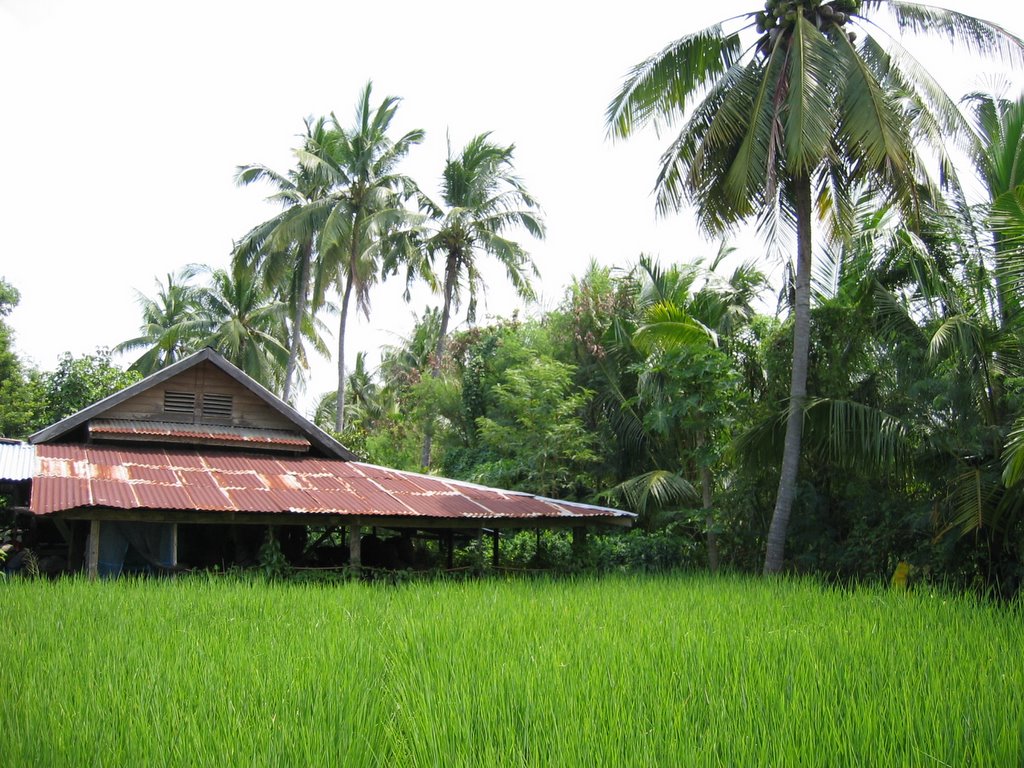 Far Eastern Economic Review - July 2005
For over four millennia, alchemists have sought to transform ordinary metals into gold. Today, it seems that a new alchemy has finally arrived to make our wildest dreams come true—genetic engineering is set to solve the problems of our age, with a long line of promises that range from the utopian to the truly bizarre.
Drought tolerant, pest resistant, crops that are rich in omega-3 essential fatty acids, will help the rich lose weight and help the poor overcome malnutrition. Researchers in Japan are reportedly developing a soy bean that includes an antihair loss gene. Apparently, the addition of human genes to rice makes it resistant to 13 different varieties of herbicide. Miracle solutions abound. But how real are the promises and what are the risks? And how are the benefits and risks of this technology shared by the wider community?
With entrenched positions on either side of the Atlantic Ocean, centre stage of the genetically engineered (ge) food debate is shifting to Asia, where most countries are developing ge varieties of crops ranging from rice to papaya, corn and potato. Among the myriad of research trials, the proposed introduction of ge rice in China is the key threshold issue. Rice is the world’s most important staple food crop and forms the basis of the diet in many countries. Up until now, no country has ever allowed their major staple food crop to be genetically engineered on a wide scale.
Corn, soy beans, canola and cotton make up the bulk of ge crops and are used mostly in animal feed. A smaller proportion goes into highly processed foods. Even the U.S.—where the growing of ge foods is widespread—has so far stopped short of introducing ge rice, even though regulatory approvals have been granted.
Proponents of ge crops are hoping that China will soon adopt ge rice, giving a green light to other Asian countries, and providing the silver bullet that overcomes global opposition to ge foods. However, to date Chinese officials have been circumspect about the applications while they consider the health and environmental risks, as well as market implications. The Chinese government is well aware that should it approve ge rice, it will be entering unknown territory in terms of exposing its population to the risks inherent in ge technology.
So why all the fuss? There are fundamental objections to the release of ge organisms into the environment and food chain, based on environmental and health risks. Many consumers simply don’t like the idea of scientists and chemical companies mucking around with their food, others have ethical or religious objections. Farmers are concerned about patent issues and the increasing corporate control over seeds and farming. And a large number of food companies have decided that the risk of consumer rejection of their products outweighs any potential benefits of ge foods and have joined the anti-ge camp.
There are many interesting and important developments in molecular biology that may help to improve the way we understand and interact with our environment—including many applications of agricultural biotechnology that hold real promise. However ge is only one specific application that results from this wider field of scientific inquiry. It is a crude technology, based on outdated science and carries with it environmental and health risks that are inherent in the ge process. As Barry Commoner, senior scientist at City University of New York said in his essay “Unraveling the dna Myth”:
The [genetic engineering] industry is based on science that is 40 years old and conveniently devoid of more recent results, which show that there are strong reasons to fear the potential consequences of transferring a dna gene between species. What the public fears is not the experimental science but the fundamentally irrational decision to let it out of the laboratory into the real world before we truly understand it.
Claims are regularly made about the safety of ge foods but these are more often made by plant breeders than by public health experts. The notion that “people have been eating ge foods for years and nobody has got sick” is utter nonsense as anyone who knows the first thing about public health will know. There is no monitoring system in place to identify any negative health impacts of ge foods anywhere in the world, and any unexpected effects are likely to be subtle and long term. Put simply, if you don’t look for problems you will be unlikely to find them. The British Medical Association recently observed that “the few robust studies that have looked for health effects have been short term and specific. There is a lack of evidence-based research with regard to medium- and long-term effects on health.”
If recent understandings of biological complexity and genetics were applied, ge crops would be discarded to the dustbin of history. The problem is that there has been such a large financial, intellectual and emotional investment in ge that the normal scientific process has been suspended and many institutions have locked themselves in to pushing this outdated technology at the expense of investing in other less risky, and perhaps more promising areas of research.
Part of the mythology of ge crops is that they are needed to feed a growing population and solve problems of malnutrition. This no doubt provides a strong motivation for well meaning scientists, but in the realpolitik of the global biotechnology industry, this is little more than a cynical public-relations ploy.
The experience with the world’s most widely grown ge crop, showed that despite claims of increased yield, roundup ready soy yields around 5% less than conventional soy. This data is rarely publicized and claims of increased yield continue despite evidence to the contrary.
The assumption that ge crops will feed the world is even more ill founded. People don’t starve because there isn’t enough food, but because they are poor and are denied access to food. In 2001, the Indian government was sued after allowing grain to rot in government granaries while innumerable starvation deaths were reported throughout the country. Many countries in Europe pay their farmers not to grow food. While in other countries, produce is routinely destroyed due to market failures.
But rather than addressing the causes of malnutrition and hunger, scientists are inventing more far-fetched, high-tech solutions to reinforce and extend a food system that is fundamentally designed to make profits for agribusiness rather than to feed people.
The other tangible argument in favor of ge crops is the notion that they will reduce pesticide use. However there are other, less risky ways to achieve this result. Farmer education and integrated pest management are obvious starting points.
The push to introduce ge rice in China and Asia seems to be driven more by the needs of the industry than by any real analysis of the problems. For example, the variety of ge rice that is first in line for approval is bacterial blight (bb) resistant rice, yet in China, bb affects only 1% to 2% of the total rice crop and the Ministry of Agriculture has not conducted any national bb infection forecast in the past two years since the disease is no longer considered to be a serious problem. In any case, there are several other promising solutions to bb available, including the use of other non-breeding methods such as crop rotation and increasing crop biodiversity.
While the regulators evaluate the risks of ge rice, Chinese scientists appear to have been taking the issue into their own hands. A number of research trials have been taking place over recent years and new evidence suggests that some of these trials may have spread out of control.
Greenpeace found ge rice available for sale in the markets in the Chinese province of Hubei. The rice was labeled as “pest resistant” rice and testing by international laboratory Genescan confirmed that the rice was in fact ge rice. Based on interviews with farmers and around 20 positive tests from numerous sources, Greenpeace estimates that between 950 and 1,200 tons of ge rice entered the food chain or rice market after last year’s harvest. This year, it is estimated that up to 13,500 tons may enter the market unless urgent action is taken.
While the Chinese government is conducting investigations into the problem, a number of other countries have begun probes to ensure that imports of Chinese rice have not been inadvertently contaminated. Japan has a zero tolerance for unauthorized ge organisms and according to the Ministry of Health, Labor and Welfare’s website, Japanese authorities will begin testing Chinese rice imports. South Korea is also looking into the possible contamination of rice imports.
The push to introduce ge crops in Asia is likely to increase in the future—and the pressure on governments to protect farmers and consumers and their national biosafety will also mount. In many ways, Asia is becoming the meat in the biotech sandwich, with a small number of transnational agrichemical companies aggressively pushing their products in order to break the trans-Atlantic political nexus.
Many industry proponents seem to hold the arrogant and patronizing view that Europeans are the only people who are concerned about the negative impacts of ge crops, and that this is due to some sort of inexplicable, cultural perversion. There seems to be a view that Asian consumers will somehow placidly accept whatever is given to them by the West. The reality is far different as recent consumer polls in Asia testify. A consumer survey in March of this year showed that awareness and concern about ge among Chinese consumers is steadily increasing. According to the survey, which was conducted by Ipsos, an international market research company at the request of Greenpeace, 73% of respondents said they would choose non-ge rice over ge rice.
Testing of products on Chinese supermarket shelves earlier this year found that several international brands that have GE -free policies in Europe, are using unlabelled ge ingredients in China—a clear case of double standards. This revelation led to a consumer outcry and resulted in several supermarket chains removing the ge products from shelves.
It is becoming increasingly clear that the biotech industry is not going to be able to use Asia as a dumping ground. Consumer and farmer rejection of ge crops is on the increase, and an increasing number of countries are implementing ge labeling laws that will give the public a right to know and a right to choose what they are eating. The introduction of such laws have been opposed tooth and nail by the U.S. government, and by the industry players who have engaged in an aggressive strategy of market bullying and an almost conscious strategy of contamination. Their intentions are expressed most eloquently by Dale Adolphe, ex-president of the Canola Council of Canada and a vociferous advocate of ge crops: “The total acreage devoted to genetically modified crops around the world is expanding. That may be what eventually brings the debate to an end. It’s a hell of a thing to say that the way we win is don’t give the consumer a choice, but that might be it.”
John Hepburn
Greenpeace International
Questioning Nanotechnology?
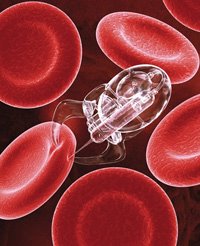 It turns out that size really does matter. Or, to be more precise, it’s the size of matter that matters. Scientists are manipulating matter at the nano scale (one billionth of a metre) and finding that common materials assume radically different properties compared to their larger scale counterparts. The new nanotechnology is being heralded as the next industrial revolution that will redefine life as we know it. But who asked for their life to be redefined? I certainly didn’t. Did you?
 If you haven’t been asked for your views on nanotechnology yet, you’re in the same position as 99.99% of the rest of the population. And it’s not as though the industry is waiting for any kind of nod of public approval. The launching pad of the global nanotechnology industry is being built with around 3,000 new nanopatents a year. In the US, nanotechnology projects have attracted more than $800 Million in public funds (mostly for military applications), making it largest research project since the Apollo moon shot. Globally, nanotech is estimated to grow to be a US$1 trillion industry by 2011 and Australia is running to catch up - with nanotech strategies and development agencies in most States.
The big deal with nanotechnology is the new properties that emerge when materials are manipulated at the nanoscale. The nano-scale material may be more reactive, have different optical, magnetic and electric properties, and be much stronger or more toxic. The list of research projects and possibilities is seemingly endless. In one of the first high profile examples of nanotechnology, IBM spelled out their corporate logo using xenon atoms to make letters that were 5 nanometres high. To put this in context, a human hair is about 80,000 nanometres wide and a red blood cell roughly 7,000 nanometres wide. So when we’re talking nano, we’re talking very very small.
It seems that the exact definition of nanotechnology shifts depending on who you are speaking to – or more importantly – what questions you are asking. If you’re an investor looking for opportunities, or a researcher looking for corporate backing, then nanotechnology is the most exciting area of cutting edge science that is going to be the basis of the next industrial revolution and will redefine both life and non-life as we know it. If on the otherhand, you happen to be asking about whether or not there needs to be some regulation of the health and environmental impacts of nanotechnology, then you’re likely to be told that nanotechnology doesn’t actually exist. After all, it’s really just the same old physics and chemistry that we’ve been doing for decades that has been ‘rebranded’ to help boost science funding.
Surely the nanotechnology industry can’t have it both ways. Or can they? As with the case of genetically engineered organisms, the industry and scientists have managed to successfully argue that nano materials are new and different in order to secure monopoly patents. And then they have then turned around and argued that the materials are in fact the same everyday stuff we’ve been using for decades so they don’t need regulation or safety testing. To date, no regulation has been required despite considerable evidence that manufactured nanoparticles can be hazardous and warrant extreme caution.
There are a wide range of concerns backed by a slowly increasing body of scientific evidence. The fact that nanoscaled substances have much higher and less predictable reactivities, increases their chances of becoming environmental toxins by enabling them bind to molecules and accumulate in organisms at high rates. Nanoparticles are also starting to raise alarm bells in terms of health impacts. Substances under 70 nm are not recognizable to our bodies’ first line of defense, white blood cells, and therefore pass readily into the bloodstream and consequently to all other parts of the body when inhaled. Researchers working in Oxford and Montreal found that titanium dioxide (currently used in sunscreens) nanoparticles catalyze the formation of free radicals in skin cells, which in turn cause damage to DNA, ultimately becoming carcinogenic. In this case it is possible that in our attempt to prevent skin cancer from excessive sun exposure that cancer will develop instead from the substance used as sunscreen.
In response to these and other concerns, The Royal Society in the UK released a report in 2004 recommending that: until more is known about environmental impacts of nanoparticles and nanotubes, their release into the environment should be avoided as far as possible; and that ingredients in the form of nanoparticles undergo a full safety assessment before they are permitted for use in products.
The problem is that nobody is listening. Products containing nanoparticles are already on the shelves, including sunscreens, cosmetics, car parts and silicon chips, and in the not so distant future we can expect them to also be used in food and pharmaceutical products. There is an urgent and growing regulatory gap where product development is being fast-tracked at the expense of ensuring community health and safety. But it is unclear what it’s going to take to trigger a regulatory response. Recommendations from one of the world’s most conservative and well-respected scientific bodies hasn’t seemed to have had much impact. Perhaps the nanotechnology industry is just waiting for the same kind of public backlash that triggered the regulation and wholesale rejection of genetically engineered foods?
Beyond the immediate health and environmental risks, the more complex and far reaching implications of nanotechnology relate to other issues and products that are a little further up the development pipeline – such as molecular manufacturing techniques for putting together products atom-by-atom, the merging of non-living nano-materials and living organisms, and even self-replicating nano-robots.
These transformative technologies raise serious social, ethical and political questions. In addition to economic upheavals, nano-surveillance and military concerns, new developments and the convergence of nanotechnology, biotechnology and artificial intelligence are bringing into question the fundamental relationships that define our society. By blurring the boundary between human and machine they question the very essence of what it is to be a human being.
The transformative power of the new nano and biotechnologies has reached a point where surely it must time for us to take the democratisation of science seriously. Over the past two hundred years, scientists have altered our world in ways that elected officials could only dream of doing. Yet they are accountable to nobody. We need a new way of thinking about science and technology that allows those who are affected by the technology to have a say in it’s development, and that allows the development of technology to be shaped by the needs and aspirations of our community – not the other way around.
This is not a trivial problem by any means. Just as scientists are exploring unchartered territory through the emerging bio and nano technologies, so must we also explore unchartered territory in terms of how these technologies are managed – and crucially, in whose interests.
Subscribe to:
Posts (Atom)